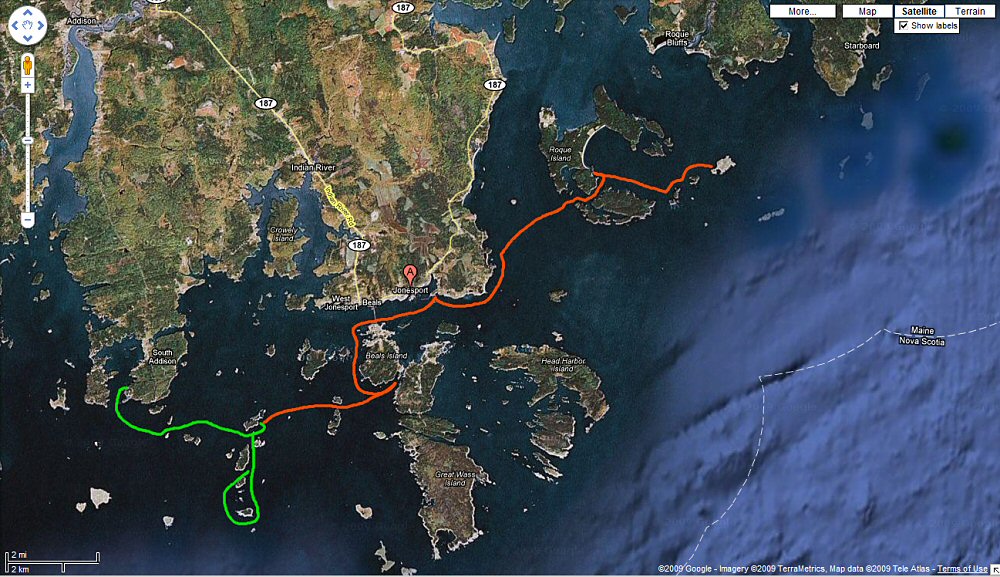
We had a 15 mile paddle to our next destination, Halifax Island. We thought we could get to the other side of Great Wass through a pinch-point between it and Beal's Island. Turned out that it was fenced off for a lobster pound, so we had to backtrack and go through Moosabec Reach, past Jonesport.

photo by Mark Stephens
Conditions started out very calm, but as we made the 2-mile crossing to the Roque Islands I was having difficulty handling the boat in the cross-currents and wind, and I was running out of energy.

photo by Mark Stephens
Finally we reached the quiet waters of the Roque Islands. We stopped on the beach to rest and eat lunch.

Here was our lunch view. We gazed out at our destination, there at the left end of the string of islands. I'd camped there before when I'd been to downeast Maine years past, and I remembered it as a magical place. There was a price to pay though: at the next-to-last island in the chain, Mark broke his carbon-fiber paddle blade. He had to use his spare for the rest of the trip.

photo by Mark Stephens
On the way to Halifax, via Double Shot Island, just before Mark broke his paddle.

We reached the beach at Halifax and set about spreading our gear to dry, after the three days of rain and fog. The beach is made of ostrich-egg-sized smooth granite rocks of the most marvelous colors and patterns: pinks and greens and blues, spotted and lined and solid-colored. Arising out of these egg-rocks are great smooth slabs of bedrock.

As usual, we set about our appointed tasks. I found this spot for the tent, amidst ferns and lowbush blueberry.

Mark made a preliminary kitchen and began making the most wonderful burritoes I've ever eaten.

That evening we hiked up the knoll at the end of the island to take in the view. This is looking back down at our campsite (the beach on the left), with the Brothers Islands in the far right and Point of Maine on the distant left. This was our domain.

Mark atop the knoll, with the Brothers Islands behind him.

Mark studies the botanical specimens, some of them arctic species.

photo by Mark Stephens
Roseroot, a sedum that grew on the outer islands.

photo by Mark Stephens
Cotton Grass, an arctic bog species that grew in swaths across Halifax.
page 5